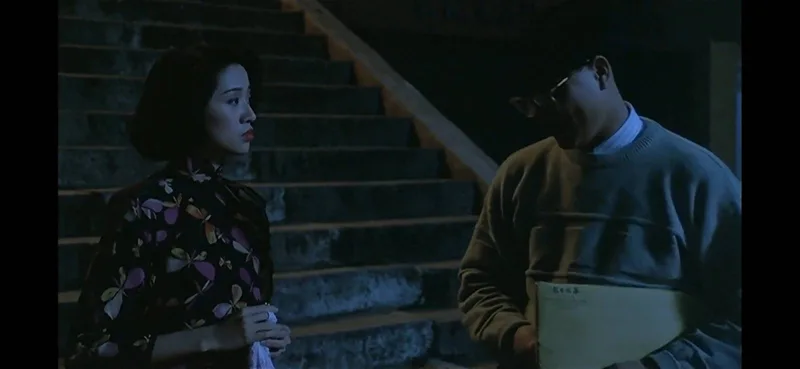

Staircases between two worlds
Sheffield’s staircases recall Rouge, where a darkly comic exchange turns “above” and “below” into a conversation between the living and the dead.
Re-imagining Hong Kong and Sheffield Through Cinema
05 / Lai Ming
An ATM scene, a Sheffield bank and a remembered song become a reflection on Hong Kong’s prosperity, endurance and change.
Click an image to view it full size / 點選圖片放大
In their words
“錦繡前程(Long and Winding Road)”made me think of 1970s Japanese TV dramas and their theme songs—especially “前程錦繡”(俺たちの旅). I used one line of the lyrics in my work as a caption: “斜陽落下心中不必驚慌”("As the twilight falls, do not let your heart be troubled.") from the theme song 前程錦繡. The piece depicts Hong Kong's prosperity in the 1990s, using that lyric to suggest how people tried for two decades—and built the “miracle” of Hong Kong.
In the scene, the main character can't withdraw money from an HSBC ATM because he has less than 100 Hong Kong dollars saved. The woman standing behind him becomes impatient and shows dissatisfaction. But the male lead embodies the calm expressed in the lyric, and—despite the obstacle—continues to work hard in Hong Kong during its golden era.
HSBC, founded in 1864 by Scottish businessmen with a “serve the local community” philosophy, was established in March 1865, with its headquarters on Queen's Road Central. It became the semi central bank to issue Hong Kong dollars with important role of Hong Kong. In 1993, with the political timeline of the 1997 handover, HSBC relocated its headquarters to London. After the Hong Kong National Security Law was enacted in 2020, accounts of democratic activists were reportedly blocked at the government's request, using political tools to control dissent.
In the end, a single line carries Hong Kong's spirit. And one image tells the story of Hong Kong's rise and decline—from its heyday to its eventual turning point.
A Hong Kong–born film lover turned diaspora, living in the UK, I turn to Hong Kong cinema to reconnect with my past and rediscover the city's charm. In those films, I find a kind of luminous endurance: the city's beauty made tangible, its streets made intimate, its emotions translated into light, rhythm, and breath. I'm still learning how, even without freedom, filmmakers in Hong Kong find creative ways to keep telling stories—proof that imagination can adapt and endure.
Sheffield’s staircases recall Rouge, where a darkly comic exchange turns “above” and “below” into a conversation between the living and the dead.
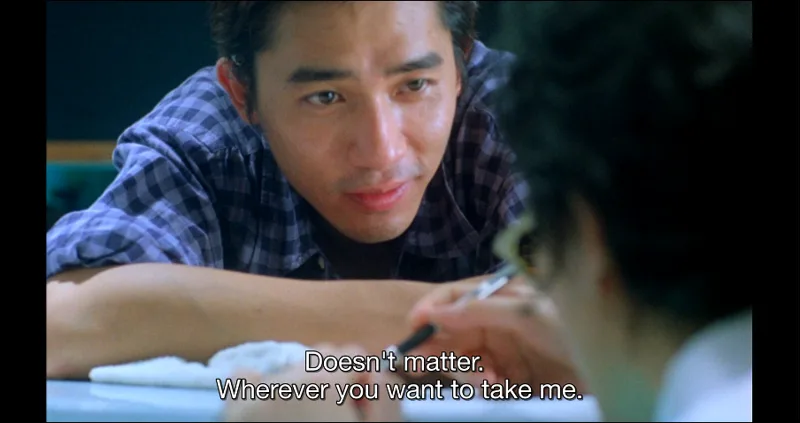
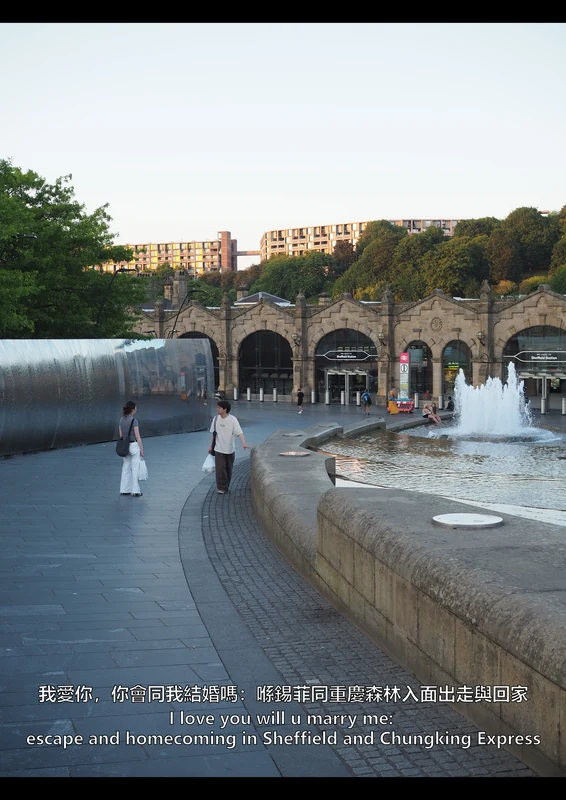
A meeting outside Sheffield Station brings Chungking Express’s dreams of departure and homecoming into a familiar city landscape.